IPv4 vs IPv6: The Ultimate Comparison & Future of the Internet
The internet is undergoing a massive, silent transition. For decades, the foundation of web communication relied entirely on Internet Protocol version 4 (IPv4). However, as the number of connected devices exploded globally, we ran into a critical problem: we literally ran out of IP addresses. Enter Internet Protocol version 6 (IPv6). This comprehensive guide breaks down the differences, the benefits, and what this transition means for you.
The Scale of the Problem
- The last top-level block of IPv4 addresses was officially exhausted in 2011.
- IPv6 provides 340,282,366,920,938,463,463,374,607,431,768,211,456 addresses. That's enough for every atom on the surface of the Earth to have its own IP address.
- Currently, roughly 45% of all global internet traffic occurs over IPv6, up from just 1% in 2013.
What is IPv4? The Legacy Protocol
Developed in the early 1980s, IPv4 is the fourth version of the Internet Protocol and the first to be widely deployed. It uses a 32-bit address space, which provides exactly 4,294,967,296 unique addresses. At the time of its creation, when computers were massive mainframes used mostly by universities and the military, 4.3 billion seemed like an impossibly large number.
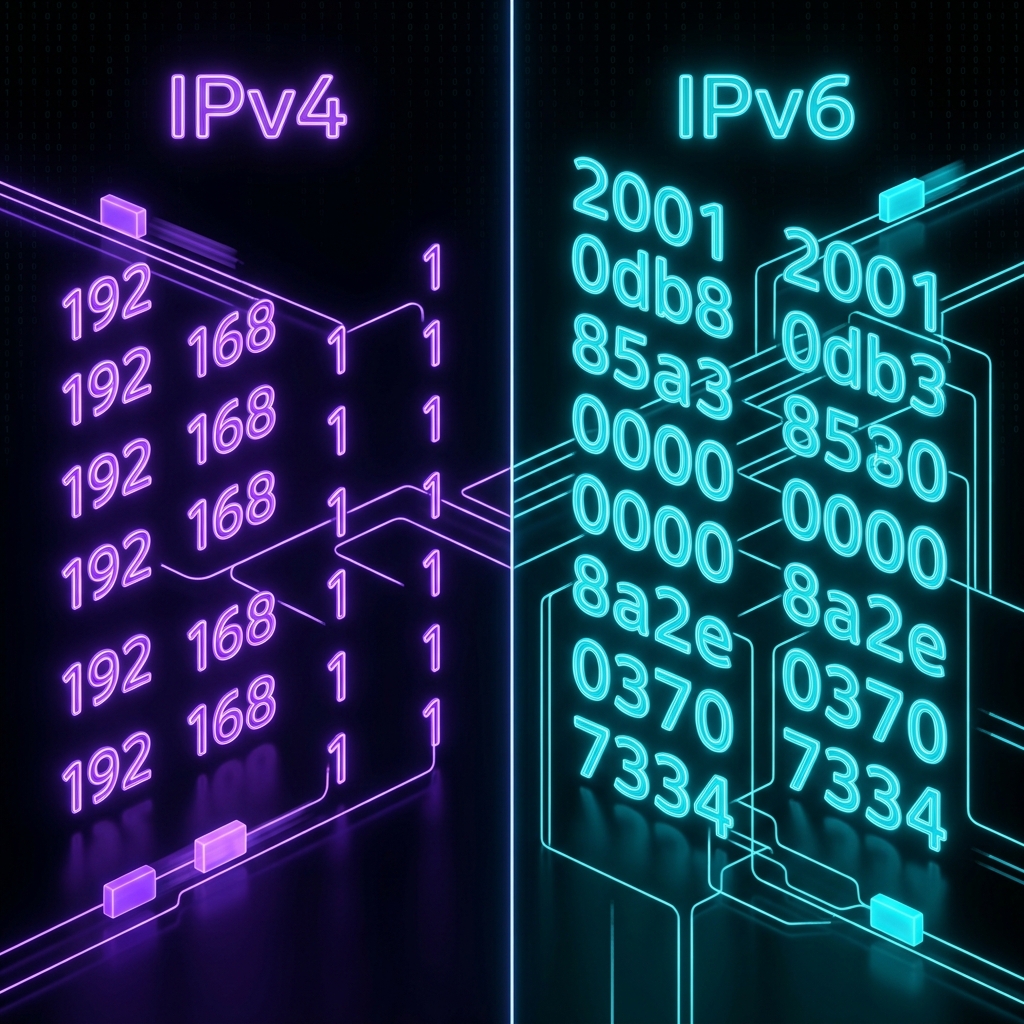
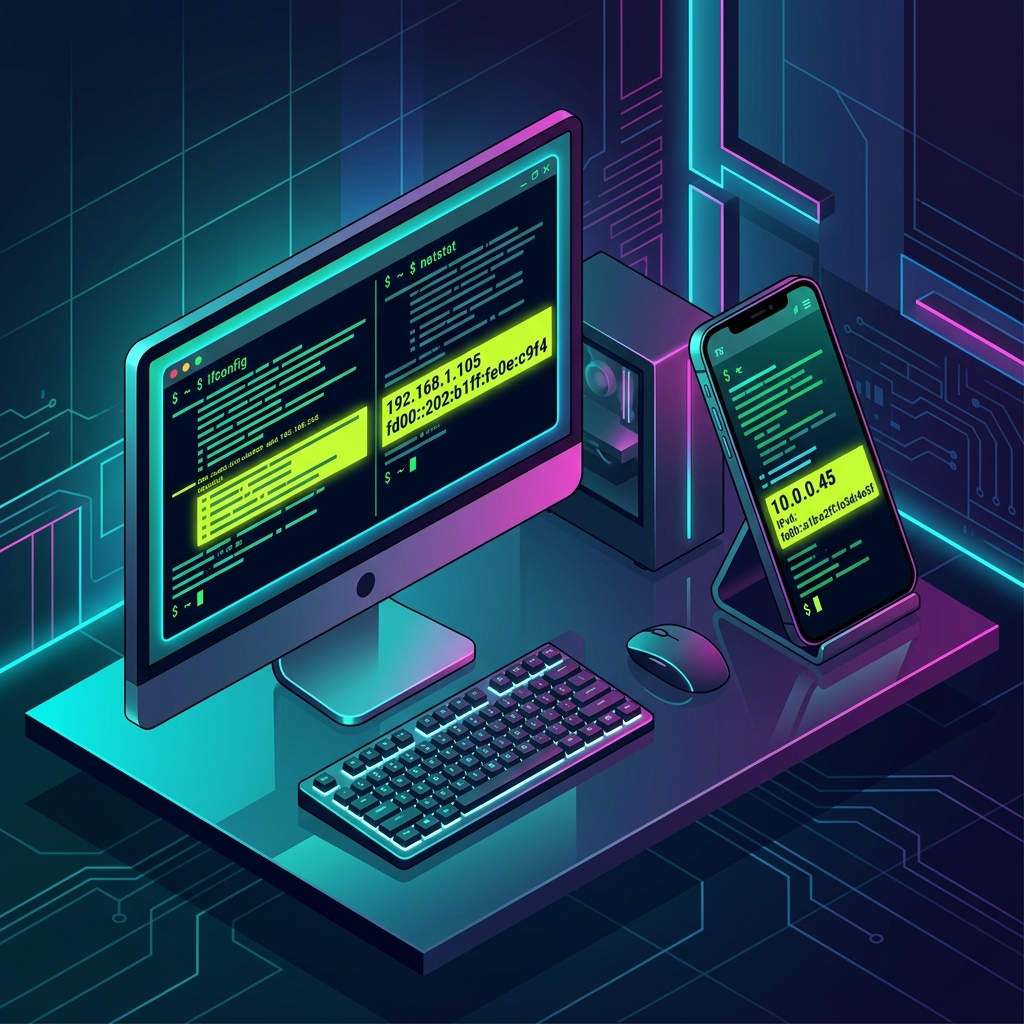
An IPv4 address looks like this: 192.168.1.1. It consists of four decimal numbers (ranging from 0 to 255) separated by dots.
The Exhaustion Problem
With the advent of smartphones, smart TVs, IoT (Internet of Things) devices, and global internet expansion, 4.3 billion addresses were simply not enough. Engineers created workarounds like Network Address Translation (NAT) to share a single public IPv4 address among multiple private devices in a home or business. While NAT delayed the inevitable, it caused networking complexities and hindered direct end-to-end communication.
What is IPv6? The Future-Proof Solution
Internet Protocol version 6 (IPv6) was designed specifically to fix the address exhaustion problem and improve upon IPv4's architecture. Instead of 32 bits, IPv6 uses a 128-bit address space. This exponential increase means we will practically never run out of addresses again.
An IPv6 address looks radically different. It consists of eight groups of four hexadecimal digits, separated by colons. Example: 2001:0db8:85a3:0000:0000:8a2e:0370:7334.
Interactive Knowledge Check
Why do IPv6 addresses use letters (a-f)?
Key Technical Improvements in IPv6
Beyond merely providing more addresses, IPv6 brings significant architectural upgrades that improve security, speed, and network management.
- No More NAT Needed: Because there are so many addresses, every single device can have its own public IPv6 address. This eliminates the need for Network Address Translation (NAT), allowing true end-to-end connectivity which improves performance for gaming, VoIP, and video conferencing.
- Built-in Security (IPsec): While IPsec can be used with IPv4, it is tightly integrated into the core framework of IPv6. This allows for native data encryption and authentication at the network layer.
- More Efficient Routing: IPv6 simplifies the packet header. By moving non-essential and optional fields to extension headers, routers process IPv6 packets faster than IPv4.
- SLAAC (Stateless Address Autoconfiguration): Devices on an IPv6 network can automatically generate their own IP address without relying on a central DHCP server.
Interactive Comparison Table: IPv4 vs IPv6
Let's look at a direct, side-by-side comparison of the two protocols.
| Feature | IPv4 | IPv6 |
|---|---|---|
| Deployed | 1981 | 1998 |
| Address Size | 32-bit number | 128-bit number |
| Format | Dotted Decimal (192.168.1.1) | Hexadecimal (2001:0db8::8a2e:0370:7334) |
| Total Addresses | ~4.3 Billion | ~340 Undecillion |
| NAT Required? | Yes, to preserve addresses | No, direct addressing |
| IPsec Security | Optional / Add-on | Native / Built-in capability |
Why Isn't Everyone Using IPv6 Yet?
If IPv6 is superior, why are we still using IPv4? The primary issue is compatibility. IPv4 and IPv6 are not backward compatible. A device speaking only IPv4 cannot natively communicate with a server speaking only IPv6. ISPs, content providers, and hardware manufacturers have to run "dual-stack" networks (running both protocols simultaneously) during the transition phase.
Upgrading entire core networks, replacing legacy hardware, and rewriting older software requires immense capital and time. However, mobile networks (like 4G/LTE and 5G) have largely driven the adoption, as they required vast amounts of IPs for smartphones that IPv4 simply couldn't provide.
Frequently Asked Questions
Is IPv6 faster than IPv4?
In many cases, yes. Because IPv6 eliminates NAT (Network Address Translation) and features a more streamlined packet header, data can be routed slightly faster. However, the difference for the average user browsing the web is often negligible in real-world scenarios.
Do I need to change my IP to IPv6 manually?
No. The transition is handled entirely by your Internet Service Provider (ISP) and your operating system. Modern devices like Windows 10/11, macOS, iOS, and Android support IPv6 out of the box and will use it automatically if your ISP supports it.
Will IPv4 stop working?
Not anytime soon. IPv4 and IPv6 will co-exist for many years via dual-stack implementation and tunneling protocols. The internet will gradually phase out IPv4 over the coming decades, but it won't be a sudden shutoff.
Related Articles